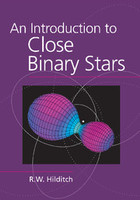
Binary systems of stars are as common as single stars. They are of fundamental importance because they allow stellar masses, radii and luminosities to be measured directly, and explain a host of diverse and energetic phenomena including X-ray binaries, cataclysmic variables, novae, symbiotic stars, and some types of supernovae. This 2001 book was the first to provide a pedagogical and comprehensive introduction to binary stars. It combines theory and observations at all wavelengths to develop a unified understanding of binaries of all categories. It comprehensively reviews methods for calculating orbits, the Roche model, ideas about mass exchange and loss, methods for analysing light curves, the masses and dimensions of different binary systems, and imaging the surfaces of stars and accretion structures. This book provides a thorough introduction to the subject for advanced undergraduate and graduate students. Researchers will also find this to be an authoritative reference.
This work has been selected by scholars as being culturally important, and is part of the knowledge base of civilization as we know it.This work is in the "public domain in the United States of...
Since the 1970s symposia or colloquia devoted to recent research on close binaries have been held around the world almost annually. At meetings of the General Assembly of the International...
Astronomers learn much of what they know about the mass, brightness, and size of stars by observing binary systems, in which two stars orbit each other, periodically cutting off the others light...
The Explosion of Binary Stars explores themes of loss in the author's own life and in the lives of her patients. The themes are universal: divorce, breast cancer, war, addiction, PTSD, aging,...
Introduction to Close Binary Systems provides a comprehensive survey and guide to the fast-moving field of multiple, specifically binary, stars, with an up to date account of research around 'close',...