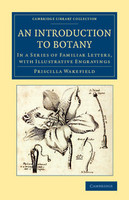
Coming from a prosperous London Quaker family, the author Priscilla Wakefield (1751-1832) wrote educational books for children, and one work for adults, Reflections on the Present Condition of the Female Sex (1798), also reissued in this series. This 1796 book on botany, a science which 'contributes to health of body and cheerfulness of disposition' but is difficult to study because of its Latin nomenclature and the cost of textbooks, offers a simple introduction for children through the medium of letters between sisters, as 'Felicia' shares with 'Constance' her growing understanding of plant science. Felicia's governess is a follower of Linnaeus, whose classificatory system is described as 'the one universally adopted', and by the twenty-eighth and final letter, Felicia is describing the class Cryptogamia. This illustrated account in simple language gives an insight into the level of education thought appropriate for young girls at the end of the eighteenth century.
Whether you're a budding botanist or simply curious about the natural world, this comprehensive guide to plant biology is an essential resource. With its clear explanations and engaging...
This is a reproduction of a book published before 1923. This book may have occasional imperfections such as missing or blurred pages, poor pictures,...
Discover the fascinating world of medical botany with 'An Introduction to Medical Botany' by Thomas Castle. This illuminating guide details the healing properties of various plants and how they have...
This work has been selected by scholars as being culturally important, and is part of the knowledge base of civilization as we know it.This work is in the "public domain in the United States of...
This work has been selected by scholars as being culturally important, and is part of the knowledge base of civilization as we know it. This work was reproduced from the original artifact, and...