
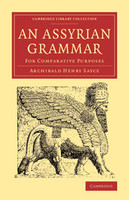
Archibald Henry Sayce (1845-1933) became interested in Middle Eastern languages and scripts while still a teenager. Old Persian and Akkadian cuneiform had recently been deciphered, and at the same time Indo-European studies had emerged as a lively field, with publications by scholars including Grimm, Bopp and Schleicher. Assyrian offered opportunities to historians of the Semitic languages similar to those provided by Avestan to Indo-Europeanists, and Sayce's grammar, published in 1872, was aimed at such an audience. Only transliteration was used, as cuneiform would be both expensive and redundant for philological purposes. In his preface, Sayce acknowledges the recent work of Oppert, Hincks, and Smith (whose translation of part of the epic tale of Gilgamesh attracted considerable publicity later that year). Sayce considers the place of Assyrian in the Semitic language family and its development over time, and reviews the archaeological evidence and scholarly literature, before presenting its phonology, morphology, syntax and prosody.
An Assyrian grammar for comparative purposes is an unchanged, high-quality reprint of the original edition of 1872.Hansebooks is editor of the literature on different topic areas such as research and...
This work has been selected by scholars as being culturally important, and is part of the knowledge base of civilization as we know it.This work is in the "public domain in the United States of...
Assyrian Grammar and Reading Book is an unchanged, high-quality reprint of the original edition of 1875.Hansebooks is editor of the literature on different topic areas such as research and science,...
This book has been considered by academicians and scholars of great significance and value to literature. This forms a part of the knowledge base for future generations. So that the book is never...