Algebraic Varieties: Minimal Models and Finite Generation
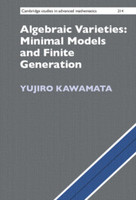
The finite generation theorem is a major achievement in modern algebraic geometry. Based on the minimal model theory, it states that the canonical ring of an algebraic variety defined over a field of characteristic 0 is a finitely generated graded ring. This graduate-level text is the first to explain this proof. It covers the progress on the minimal model theory over the last 30 years, culminating in the landmark paper on finite generation by Birkar‒Cascini‒Hacon‒McKernan. Building up to this proof, the author presents important results and techniques that are now part of the standard toolbox of birational geometry, including Mori's bend-and-break method, vanishing theorems, positivity theorems, and Siu's analysis on multiplier ideal sheaves. Assuming only the basics in algebraic geometry, the text keeps prerequisites to a minimum with self-contained explanations of terminology and theorems.
In this book Professor Kempf gives an introduction to the theory of algebraic functions on varieties from a sheaf theoretic standpoint. By taking this view he is able to give a clean and lucid...
This book gives a systematic presentation of real algebraic varieties. Real algebraic varieties are ubiquitous.They are the first objects encountered when learning of coordinates, then equations, but...
The book covers topics in the theory of algebraic transformation groups and algebraic varieties which are very much at the frontier of mathematical research.
A mathematically precise definition of the intuitive notion of "algorithm" was implicit in Kurt Godel's [1931] paper on formally undecidable propo sitions of arithmetic. During the 1930s, in the...