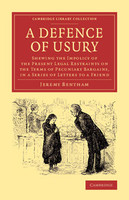
The utilitarian philosopher and jurist Jeremy Bentham (1748-1832) argues in this collection of letters for the cessation of government control of the rate of interest. The work first appeared in 1787 and is reissued here in the version published in Dublin in 1788. The final letter, addressed to Adam Smith, is a response to Smith's Wealth of Nations (1776), arguing against the limits to inventive industry forced by the restriction on rates. Throughout the work is Bentham's emphasis on the value, both ethical and practical, of allowing private citizens to regulate their own financial dealings. Bentham offers a sophisticated philosophical, economic and political analysis of 'usury' and in so doing provides a template for a wider liberal view. Influential at the time of publication, the work still retains its significance in making a case for the proper relationship between the individual and the state.
The Making of the Modern Law: Legal Treatises, 1800-1926 includes over 20,000 analytical, theoretical and practical works on American and British Law. It includes the writings of major legal...
The Making of the Modern Law: Legal Treatises, 1800-1926 includes over 20,000 analytical, theoretical and practical works on American and British Law. It includes the writings of...
The Making of the Modern Law: Legal Treatises, 1800-1926 includes over 20,000 analytical, theoretical and practical works on American and British Law. It includes the writings of major legal...
In this landmark work, Grahame argues passionately for the retention of usury laws that limit the interest rates that lenders can charge. He takes issue with Bentham's utilitarian arguments in favor...
This work has been selected by scholars as being culturally important, and is part of the knowledge base of civilization as we know it. This work was reproduced from the original artifact, and...