Trending Bestseller

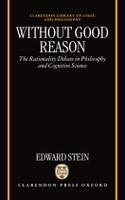
Without Good Reason

No reviews yet Write a Review
Are humans rational? Various experiments performed over the last several decades have been interpreted as showing that humans are irrational; certain philosophers, on the other hand, have argued that it is a conceptual truth that humans must be rational. Without Good Reason offers a clear critical account of the rationality debate in philosophy and cognitive science, concluding that the question of human rationality is indeed an empirical one not a conceptual one.
Hardback
11-January-1996
RRP: $265.00
$192.00
Ships in 3-5 business days
Hurry up! Current stock:
Are humans rational? Various experiments performed over the last several decades have been interpreted as showing that humans are irrational--we make significant and consistent errors in logical reasoning, probabilistic reasoning, similarity judgements, and risk-assessment, to name a few areas. But can these experiments establish human irrationality, or is it a conceptual truth that humans must be rational, as various philosophers have argued? In this book, Edward Stein offers a clear critical account of this debate about rationality in philosophy and cognitive science. He discusses concepts of rationality--the pictures of rationality that the debate centres on--and assesses the empirical evidence used to argue that humans are irrational. He concludes that the question of human rationality must be answered not conceptually but empirically, using the full resources of an advanced cognitive science. Furthermore, he extends this conclusion to argue that empirical considerations are also relevant to the theory of knowledge--in other words, that epistemology should be naturalized.

This product hasn't received any reviews yet. Be the first to review this product!

RRP: $265.00
$192.00
Ships in 3-5 business days
Hurry up! Current stock:

Without Good Reason

RRP: $265.00
$192.00

Description

Are humans rational? Various experiments performed over the last several decades have been interpreted as showing that humans are irrational--we make significant and consistent errors in logical reasoning, probabilistic reasoning, similarity judgements, and risk-assessment, to name a few areas. But can these experiments establish human irrationality, or is it a conceptual truth that humans must be rational, as various philosophers have argued? In this book, Edward Stein offers a clear critical account of this debate about rationality in philosophy and cognitive science. He discusses concepts of rationality--the pictures of rationality that the debate centres on--and assesses the empirical evidence used to argue that humans are irrational. He concludes that the question of human rationality must be answered not conceptually but empirically, using the full resources of an advanced cognitive science. Furthermore, he extends this conclusion to argue that empirical considerations are also relevant to the theory of knowledge--in other words, that epistemology should be naturalized.
Customers Also Viewed