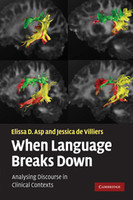
Doctors, nurses, and other caregivers often know what people with Alzheimer's disease or Asperger's 'sound like' - that is they recognise patterns in people's discourse, from sounds and silences, to words, sentences and story structures. Such discourse patterns may inform their clinical judgements and affect the decisions they make. However, this knowledge is often tacit, like recognising a regional accent without knowing how to describe its features. This is the first book to present models for comprehensively describing discourse specifically in clinical contexts and to illustrate models with detailed analyses of discourse patterns associated with degenerative (Alzheimer's) and developmental (autism spectrum) disorders. The book is aimed not only at advanced students and researchers in linguistics, discourse analysis, speech pathology and clinical psychology but also at researchers, clinicians and caregivers for whom explicit knowledge of discourse patterns might be helpful.
In Newton's view, all objects exert a force that attracts other objects. That universal law of gravitation worked pretty well for predicting the motion of planets as well as objects on Earth and it's...
Gabi was born to play polo, but her career opportunities are far from abundant. She'd have her best shot at her goal if she could move from Brazil to the U.S., where many of her family and friends...