Trending Bestseller

Visceral Sensory Neuroscience

No reviews yet Write a Review
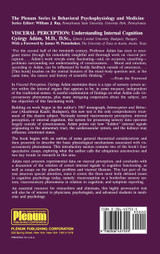
The term Interception refers to information that is sent by the nervous system from the body to the brain. Despite its importance in the control of visceral organ function, emotional-motivational processes, and in psychosomatic disorders, the topic has not received as much attention as central functions of the nervous system. This book provides the first review of the field and will be of interest to scientists in neurobiology, psychology, and brain imaging, to individuals in related clinical fields such as psychiatry, neurology, cardiology, gastroenterology, and clinical psychology, and to their students and trainees.
Hardback
01-February-2002
RRP: $209.00
$119.00
Ships in 5–7 business days
Hurry up! Current stock:
It has been known for over a century that there is an afferent(body-to-brain), as well as an efferent(brain-to-body), component to the visceral-atonomic nervous system. Despite the fundamental importance of bodily afferent information- sometimes called interoception- to central nervous system control of visceral organ function, emotional-motivational processes, and dysfunction of these processes, including psychosomatic disorders, its role did not receive much attention until quite recently. This is the first comprehensive review of this topic and it covers both neurobiological and psychobiological aspects. The author first defines the issue and gives an historical background starting with the James-Lange theory of emotion, and addresses learning and motivation, roots in Pavlovian conditioning research, and operant conditioning of visceral function. In the second section he reviews recent scientific findings in the neural basis of visceral perception and studies in cardiovascular-respiratory and alimentary interoception. Finally, he discusses several related areas of research and theory including drug state issues, interoception and psychiatric disorders, and bodily consciousness, and suggests directions for future investigation. The book will be of interest to scientists in neurobiology, psychology, and brain imaging, to indivuals in related clinical fields such as psychiatry, neurology, cardiology, gastroenterology, and clinical psychology, and to their students and trainees.

This product hasn't received any reviews yet. Be the first to review this product!

RRP: $209.00
$119.00
Ships in 5–7 business days
Hurry up! Current stock:

Visceral Sensory Neuroscience

RRP: $209.00
$119.00

Description

It has been known for over a century that there is an afferent(body-to-brain), as well as an efferent(brain-to-body), component to the visceral-atonomic nervous system. Despite the fundamental importance of bodily afferent information- sometimes called interoception- to central nervous system control of visceral organ function, emotional-motivational processes, and dysfunction of these processes, including psychosomatic disorders, its role did not receive much attention until quite recently. This is the first comprehensive review of this topic and it covers both neurobiological and psychobiological aspects. The author first defines the issue and gives an historical background starting with the James-Lange theory of emotion, and addresses learning and motivation, roots in Pavlovian conditioning research, and operant conditioning of visceral function. In the second section he reviews recent scientific findings in the neural basis of visceral perception and studies in cardiovascular-respiratory and alimentary interoception. Finally, he discusses several related areas of research and theory including drug state issues, interoception and psychiatric disorders, and bodily consciousness, and suggests directions for future investigation. The book will be of interest to scientists in neurobiology, psychology, and brain imaging, to indivuals in related clinical fields such as psychiatry, neurology, cardiology, gastroenterology, and clinical psychology, and to their students and trainees.

Customers Also Viewed