Turbulence is a huge subject of ongoing research. This book bridges the modern development in dynamical systems theory and the theory of fully developed turbulence. Many solved and unsolved problems in turbulence have equivalencies in simple dynamical models, which are much easier to handle analytically and numerically. This book gives a modern view of the subject by first giving the essentials of the theory of turbulence before moving on to shell models. These show much of the same complex behaviour as fluid turbulence, but are much easier to handle analytically and numerically. Any necessary maths is explained and self-contained, making this book ideal for advanced undergraduates and graduate students, as well as researchers and professionals, wanting to understand the basics of fully developed turbulence.
This book provides the first graduate-level, self-contained introduction to recent developments that lead to the formulation of the configuration-interaction approach for open quantum systems, the...
The aim of this book is to give, within a single volume, an introduction to the fields of turbulence modelling and transition-to-turbulence prediction, and to provide the physical background for...
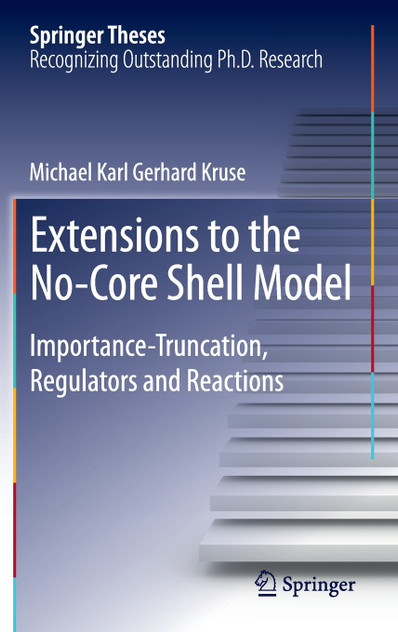
Extensions to the No-Core Shell Model presents three extensions to the No-Core Shell Model (NCSM) that allow for calculations of heavier nuclei, specifically for the p-shell nuclei. The...
This title provides the fundamental bases for developing turbulence models on rational grounds. The main different methods of approach are considered, ranging from statistical modelling at various...