Trending Bestseller

The Unvarnished Doctrine

Steven M. Dworetz

No reviews yet Write a Review
Paperback / softback
266 Pages
$61.00
Ships in 3-5 business days
Hurry up! Current stock:
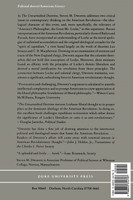
In The Unvarnished Doctrine, Steven M. Dworetz addresses two critical issues in contemporary thinking on the American Revolutionundefined;the ideological character of this event, and, more specifically, the relevance of undefined#34;Americaundefined;s Philosopher, the Great Mr. Locke,undefined#34; in this experience. Recent interpretations of the American revolution, particularly those of Bailyn and Pocock, have incorporated an understanding of Locke as the moral apologist of unlimited accumulation and the original ideological crusader for the undefined#34;spirit of capitalism,undefined#34; a view based largely on the work of theorists Leo Strauss and C. B. Macpherson. Drawing on an examination of sermons and tracts of the New England clergy, Dworetz argues that the colonists themselves did not hold this conception of Locke. Moreover, these ministers found an affinity with the principles of Lockeundefined;s theistic liberalism and derived a moral justification for revolution from those principles. The connection between Locke and colonial clergy, Dworetz maintains, constitutes a significant, radicalizing force in American revolutionary thought.

This product hasn't received any reviews yet. Be the first to review this product!

$61.00
Ships in 3-5 business days
Hurry up! Current stock:

The Unvarnished Doctrine

$61.00

Description

In The Unvarnished Doctrine, Steven M. Dworetz addresses two critical issues in contemporary thinking on the American Revolutionundefined;the ideological character of this event, and, more specifically, the relevance of undefined#34;Americaundefined;s Philosopher, the Great Mr. Locke,undefined#34; in this experience. Recent interpretations of the American revolution, particularly those of Bailyn and Pocock, have incorporated an understanding of Locke as the moral apologist of unlimited accumulation and the original ideological crusader for the undefined#34;spirit of capitalism,undefined#34; a view based largely on the work of theorists Leo Strauss and C. B. Macpherson. Drawing on an examination of sermons and tracts of the New England clergy, Dworetz argues that the colonists themselves did not hold this conception of Locke. Moreover, these ministers found an affinity with the principles of Lockeundefined;s theistic liberalism and derived a moral justification for revolution from those principles. The connection between Locke and colonial clergy, Dworetz maintains, constitutes a significant, radicalizing force in American revolutionary thought.

Customers Also Viewed