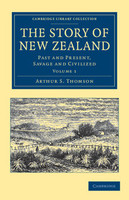

Arthur S. Thomson (1816-60) was a Scottish military surgeon and medical scientist who was posted to New Zealand in the late 1840s. During his eleven years in the country, settlement increased and British sovereignty over the colony was extended. Thomson felt that previous historical accounts of New Zealand all demonstrated a certain political, colonial or religious bias, and decided to write his own comprehensive history of the islands, which was published in 1859. Volume 1 begins with a focus on the geography and climate of New Zealand. Thomson then describes the physical appearance of the New Zealanders, their way of life, their culture, their property laws and the origin of their (now abandoned) cannibalism. Next he describes the history of discovery and settlement by Europeans, who brought 'true civilisation' to the islands. Thomson gives especial credit to the Christian missionaries for having introduced progress and enlightenment.
This work has been selected by scholars as being culturally important, and is part of the knowledge base of civilization as we know it.This work is in the "public domain in the United States of...
Many of the earliest books, particularly those dating back to the 1900s and before, are now extremely scarce and increasingly expensive. We are republishing these classic works in affordable, high...
This work has been selected by scholars as being culturally important, and is part of the knowledge base of civilization as we know it. This work was reproduced from the original artifact, and...
""The Story of a New Zealand River"" is a novel written by Jane Mander and first published in 1920. The story is set in the early 1900s and follows the life of a young girl named Alice Roland, who...