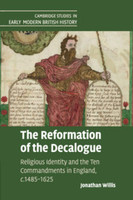
The Reformation of the Decalogue tells two important but previously untold stories: of how the English Reformation transformed the meaning of the Ten Commandments, and of the ways in which the Ten Commandments helped to shape the English Reformation itself. Adopting a thematic structure, it contributes new insights to the history of the English Reformation, covering topics such as monarchy and law, sin and salvation, and Puritanism and popular religion. It includes, for the first time, a comprehensive analysis of surviving Elizabethan and Early Stuart 'commandment boards' in parish churches, and presents a series of ten case studies on the Commandments themselves, exploring their shifting meanings and significance in the hands of Protestant reformers. Willis combines history, theology, art history and musicology, alongside literary and cultural studies, to explore this surprisingly neglected but significant topic in a work that refines our understanding of British history from the 1480s to 1625.
Do not love the dead. Do not hate the living. For life and world are one thing, and you are both, present in the second but the fullest presence of the first. Now the jaguar stood up and swaggered...
A farmer discovers a stone in the New Mexico desert engraved with the Ten Commandments-in ancient Phoenician Hebrew, a language dead for 2,000 years.Dr. Vivian Guthrie, director of the National...
This is a reproduction of a book published before 1923. This book may have occasional imperfections such as missing or blurred pages, poor pictures, errant marks, etc. that were either part of the...
This religious text provides interpretive analysis of the book of Deuteronomy and the Ten Commandments, exploring their historical and cultural context and discussing their significance for...