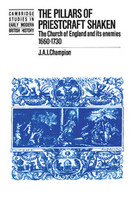
First published in 1992, this book examines the intellectual confrontation between priest and Freethinker from 1660 to 1730, and the origins of the early phase of the Enlightenment in England. Through an analysis of the practice of historical writing in the period, Champion maintains that historical argument was a central component for displaying defences of true religion. Taking religion, and specifically defences of the Church of England after 1660, as central to the politics of the period, the first two chapters of the book explore the varieties of clericalist histories, arguing that there were rival emphases upon regnum or sacerdos as the font of true religion. The remainder of the book examines how radical Freethinkers like John Toland or the third Earl of Shaftesbury set about attacking the corrupt priestcraft of established religion, but also importantly promoted a reforming civil theology.
The Pillars of Priestcraft and Orthodoxy Shaken is a radical critique of organized religion and the power structures that support it. Written by Richard Baron, this book challenges the traditional...
This work has been selected by scholars as being culturally important, and is part of the knowledge base of civilization as we know it. This work was reproduced from the original artifact, and...
This is a reproduction of a book published before 1923. This book may have occasional imperfections such as missing or blurred pages, poor pictures, errant marks,...
Priestcraft is a book written by Frank Robertson and published in 1867. The book is a critical analysis of the role and practices of priests in the Christian church. Robertson argues that priests...
This work has been selected by scholars as being culturally important, and is part of the knowledge base of civilization as we know it. This work was reproduced from the original artifact, and...