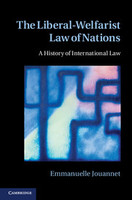

Although portrayed as a liberal law of co-existence of and co-operation between states, international law has always been a welfarist law, too. Emerging in eighteenth-century Europe, it soon won favour globally. Not only did it minister to the interests of states and their concern for stability, but it was also an interventionist law designed to ensure the happiness and well-being of peoples. Hence international law initially served as a secularised eschatological model, replacing the role of religion in ensuring the proper ordering of mankind, which was held to be both one and divided. That initial vision still drives our post-Cold War globalised world. Contemporary international law is neither a strictly welfarist law nor a strictly liberal law, but is in fact a liberal-welfarist law. In the conjunction of these two purposes lies one of the keys to its meaning and a partial explanation for its continuing ambivalence.
Winner of the 1988 Paul Reuter Prize awarded by the International Committee of the Red Cross for a major work in the field of humanitarian law. This book examines two branches of the international...
This work has been selected by scholars as being culturally important, and is part of the knowledge base of civilization as we know it. This work was reproduced from the original artifact, and...
Has global liberalism made the nation-state obsolete? Or, on the contrary, are primordial nationalist hatreds overwhelming cosmopolitanism? To assert either theme without serious qualification,...
This book, first published in 1987, examines the experience of the North Vietnamese economy during the struggle for national reunification and the Vietnam war. It chronicles the impact of war and...