Common-law judgments tend to be more than merely judgments, for judges often make pronouncements that they need not have made had they kept strictly to the task in hand. Why do they do this? The Intricacies of Dicta and Dissent examines two such types of pronouncement, obiter dicta and dissenting opinions, primarily as aspects of English case law. Neil Duxbury shows that both of these phenomena have complex histories, have been put to a variety of uses, and are not amenable to being straightforwardly categorized as secondary sources of law. This innovative and unusual study casts new light on - and will prompt lawyers to pose fresh questions about - the common law tradition and the nature of judicial decision-making.
This is a reproduction of a book published before 1923. This book may have occasional imperfections such as missing or blurred pages, poor pictures, errant marks,...
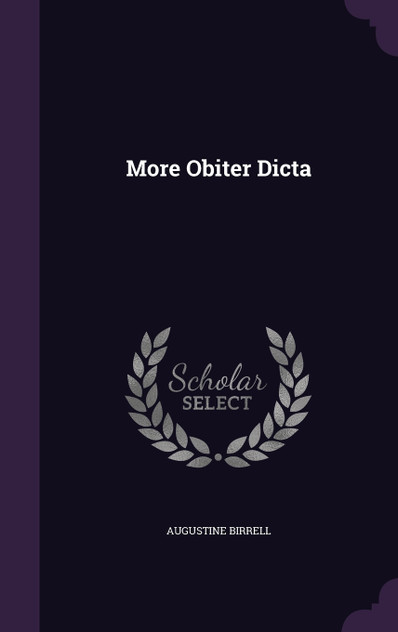
This book is a collection of essays on a wide range of subjects, including literature, politics, and social commentary. The author's wit and wisdom are on full display, making for an entertaining and...
This work has been selected by scholars as being culturally important, and is part of the knowledge base of civilization as we know it. This work was reproduced from the original artifact, and...
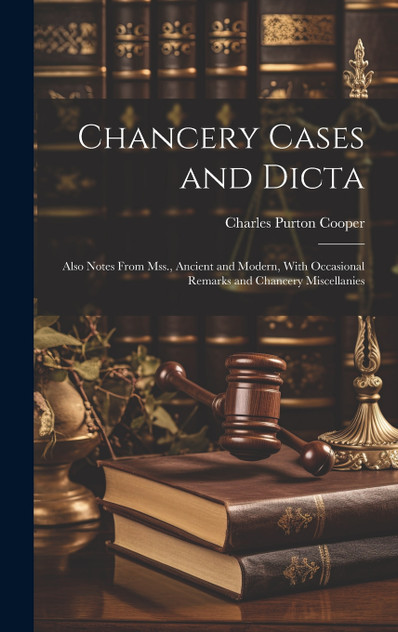
A comprehensive collection of legal cases and notes on the Chancery Court, compiled by Charles Purton Cooper. This book includes insights from both ancient and modern sources, offering a unique...
Are you even fed up of searching by looking over various websites and search engines on different platforms and applications about 'WHAT TO DO TO GET MORE ?? , or 'WHAT TO DO IN A BETTER WAY ???""...