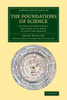
A member of the Académie française, Henri Poincaré (1854-1912) was one of the greatest mathematicians and theoretical physicists of the late nineteenth and early twentieth centuries. His discovery of chaotic motion laid the foundations of modern chaos theory, and he was acknowledged by Einstein as a key contributor in the field of special relativity. He earned his enduring reputation as a philosopher of mathematics and science with this elegantly written work, which was first published in French as three separate essays: Science and Hypothesis (1902), The Value of Science (1905), and Science and Method (1908). Poincaré asserts that much scientific work is a matter of convention, and that intuition and prediction play key roles. George Halsted's authorised 1913 English translation retains Poincaré's lucid prose style, presenting complex ideas for both professional scientists and those readers interested in the history of mathematics and the philosophy of science.
This book has been considered by academicians and scholars of great significance and value to literature. This forms a part of the knowledge base for future generations. So that the book is never...
This book constitutes an anthology of refereed papers arranged to acknowledge the work of Wilfried Brauer on the occasion of his sixtieth birthday. The volume presents 49 revised refereed papers...