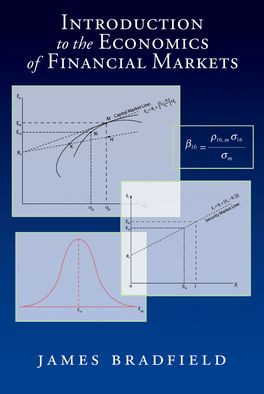
The Economics of Financial Markets presents a concise overview of capital markets, suitable for advanced undergraduates and for beginning graduate students in financial economics. Following a brief overview of financial markets - their microstructure and the randomness of stock market prices - this textbook explores how the economics of uncertainty can be applied to financial decision-making. The mean-variance model of portfolio selection is discussed, with analysis extended to the capital asset pricing model (CAPM). Arbitrage plays a pivotal role in finance and is studied in a variety of contexts, including the APT model of asset prices. Methods for the empirical evaluation of CAPM and APT are also discussed, together with the volatility of asset prices, the intertemporal CAPM and the equity premium puzzle. An analysis of bond contracts leads into an assessment of theories of the term structure of interest rates. Finally, financial derivatives are explored, focusing on futures and options contracts.
This book develops the theory of interest rates for finance students, inclusive of risk considerations that are deeply relevant in their other finance courses that take account of modern...
Energy issues feature frequently in the economic and financial press. Specific examples of topical energy issues come from around the globe and often concern economics and finance. The importance of...
There are many textbooks for business students that provide a systematic, introductory development of the economics of financial markets. However, there are as yet no introductory textbooks aimed at...
This book explores the interplay between financial markets, economic systems, and society. Through introducing the concept of autopoiesis, based on the newly conceived Autopoietic Market Hypothesis,...
Money is a standard unit that functions as a recognized medium of exchange for transactional purposes. The main functions of money are unit of account, store of value and standard of deferred payment...