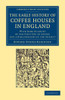

Coffee houses played an important role in the cultural and intellectual history of the seventeenth century. Functioning as venues where people could meet, catch up with news, transact business and discuss issues of mutual concern, they provided a valuable alternative to public houses: the absence of alcohol allowed for more serious conversation. First published in 1893, this illustrated study by Edward Forbes Robinson (fl.1890) explores the history of the English coffee house and its role in seventeenth-century social and political life. Beginning with a history of coffee itself, Robinson examines the religious traditions surrounding the beverage, moving on to discuss its medical uses and the clientele who frequented the establishments that served it. The role of the coffee house as a temperance institution is also considered. With an appendix containing a selection of contemporary texts and descriptions of coffee house tokens, this lively study remains significant to social historians.
This work has been selected by scholars as being culturally important, and is part of the knowledge base of civilization as we know it.This work is in the "public domain in the United States of...
Coffee Houses and Coffee Palaces in England is a historical book written by James Freeman Clarke in 1882. The book is a comprehensive account of the coffee culture in England during the 18th and 19th...
The Making of the Modern Law: Legal Treatises, 1800-1926 includes over 20,000 analytical, theoretical and practical works on American and British Law. It includes the writings of...
This work has been selected by scholars as being culturally important, and is part of the knowledge base of civilization as we know it.This work is in the "public domain in the United States of...