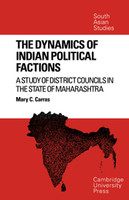
This study constitutes an analysis of factionalism between rival groups in the dominant Congress Party in Maharashtra. The principal question examined is whether a politician's decision to oppose or 'rebel against' party authority is determined or can be predicted by certain characteristics of the individual concerned and his environment (e.g. the amount of land he owns, or the level of education, urbanization, prosperity, etc., of the area in which he operates politically). About 160 Congress Party members on four district councils were interviewed, and their answers provided the main source of information for the analysis. The legally defined jurisdiction of the district councils is rural Maharashtra, and the political factions examined thus operate in a rural milieu.
REVIEWS: CHOICE 1965: "One of the very few really excellent books on Indian politics in the last 20 years . there is no other comparable work in existence."INTERNATIONAL AFFAIRS: "Nobody who wants to...
This book addresses the nature of factionalism in parties that are created or rebuilt after a period of dictatorship. It maintains that, while party leaders often view factions in negative terms as...
A free open access ebook is available upon publication. Learn more at www.luminosoa.org.The Endurance of Palestinian Political Factions is an ethnographic study of Palestinian political...