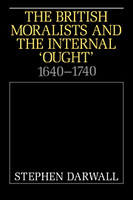
This book is a major work in the history of ethics, and provides the first study of early modern British philosophy in several decades. Professor Darwall discerns two distinct traditions feeding into the moral philosophy of the seventeenth and eighteenth centuries. On the one hand, there is the empirical, naturalist tradition, comprising Hobbes, Locke, Cumberland, Hutcheson, and Hume, which argues that obligation is the practical force that empirical discoveries acquire in the process of deliberation. On the other hand, there is a group including Cudworth, Shaftesbury, Butler, and in some moments Locke, which views obligation as inconceivable without autonomy and which seeks to develop a theory of the will as self-determining.
Edited by the philosopher and historian P.H. Nidditch, this collection of writings by British moralists offers insights into the ethical and philosophical debates of the eighteenth century. Featuring...
British Moralists V2: Being Selections From Writers Principally Of The Eighteenth Century is a book edited by Lewis Amherst Selby-Bigge and published in 1897. The book is a collection of writings...
The British Moralist V1: Or Young Gentleman And Lady�������s Polite Preceptor is a book written by Henry Brooke and published in 1771. The book is intended to be a guide for young people,...
This work has been selected by scholars as being culturally important, and is part of the knowledge base of civilization as we know it.This work is in the "public domain in the United States of...