Moncure Conway (1832-1907) was born on his family's plantation in Virginia, but became a committed abolitionist soon after he left college. He joined abolitionist rallies and moved from Methodism to the Unitarian ministry, eventually becoming a freethinker. Conway became increasingly isolated from his family as a result of his abolitionist activism, his marriage to an abolitionist, and the resettling of a group of his father's escaped slaves in Ohio during the civil war. This book was published in 1865, soon after he settled in Britain, where he lived for over 30 years, became a supporter of women's suffrage, and networked with intellectuals including Dickens, Carlyle, Lyell and Darwin. His description of the injustices of slavery, including the slave trading in the southern plantations that triggered the secession of southern states and the civil war, is set in the context of his personal experiences and his evolving ethical views.
This work has been selected by scholars as being culturally important, and is part of the knowledge base of civilization as we know it. This work was reproduced from the original artifact, and...
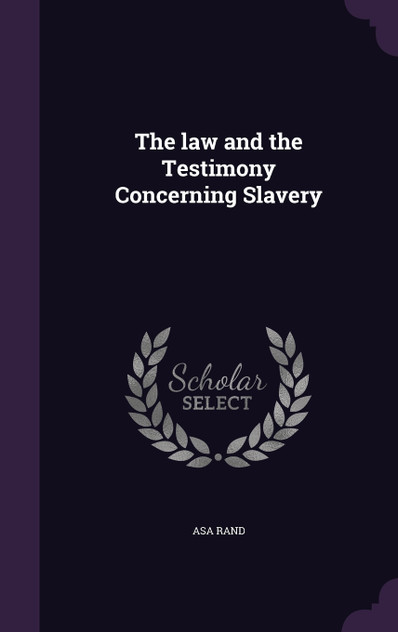
This book is a collection of biblical passages that argue against slavery and the treatment of humans as property. The book also includes notes and the testimony of the civilized world against...
This is a reproduction of a book published before 1923. This book may have occasional imperfections such as missing or blurred pages, poor pictures, errant marks, etc. that were either part of the...
This work has been selected by scholars as being culturally important, and is part of the knowledge base of civilization as we know it. This work was reproduced from the original artifact, and...
The Testimony of the Four Gospels Concerning Jesus Christ is an unchanged, high-quality reprint of the original edition of 1896.Hansebooks is editor of the literature on different topic areas such as...