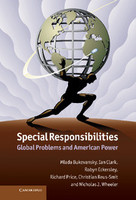

The language of special responsibilities is ubiquitous in world politics, with policymakers and commentators alike speaking and acting as though particular states have, or ought to have, unique obligations in managing global problems. Surprisingly, scholars are yet to provide any in-depth analysis of this fascinating aspect of world politics. This path-breaking study examines the nature of special responsibilities, the complex politics that surround them and how they condition international social power. The argument is illustrated with detailed case-studies of nuclear proliferation, climate change and global finance. All three problems have been addressed by an allocation of special responsibilities, but while this has structured politics in these areas, it has also been the subject of ongoing contestation. With a focus on the United States, this book argues that power must be understood as a social phenomenon and that American power varies significantly across security, economic and environmental domains.
A handbook for investing with impact and building a share portfolio that reflects your values When it comes to share investing, how you choose to invest your money can create real global impact. Your...
This work has been selected by scholars as being culturally important, and is part of the knowledge base of civilization as we know it.This work is in the "public domain in the United States of...
This book offers a collection of exercises for students of Latin prose preparing to take the Responsions exam at the University of Oxford. The passages included are taken from exams set in the...
This Special Issue gathers original studies (eight articles and one review) that aim to improve our knowledge concerning mycotoxin toxicity. The most recent research concerning the impact of...