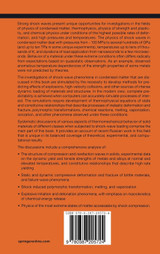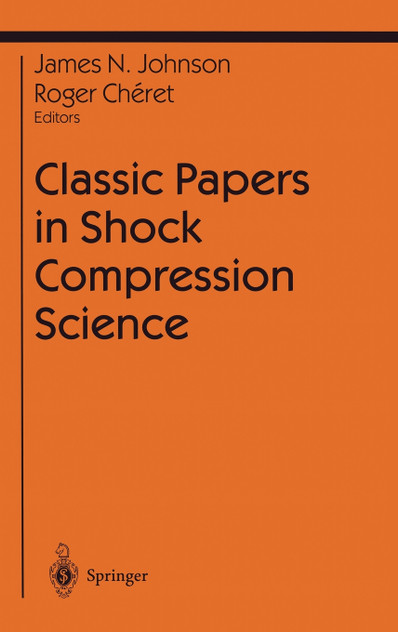

This unique publication summarises fifty years of Russian research on shock compression of condensed matter using chemical and nuclear explosions. This information, and the equations of state derived from it, have important applications in physics, materials science and engineering. An introductory chapter describes the importance of Russian experiments in a global context. The second chapter describes the experimental devices used. Following chapters summarise the results of experiments on pure metals, metal alloys and compounds, minerals, rocks, organic solids and liquids. The book covers experiments with pressures ranging from 2.5 GPa to 1 TPa using chemical explosives in laboratory conditions and to 10 TPa in underground nuclear tests. Attention is given to theoretical aspects, experimental problems, and data analysis. The data in this book are quite unique as, with the cessation of large scale underground nuclear tests, it will be some time before similar pressures can be generated by alternative means. This book will be of interest to condensed matter physicists, material scientists, earth scientists and astrophysicists.
The field of shock compression science has a long and rich history involving contributions of mathematicians, physicists and engineers over approximately two hundred years. The middle of the...
This book highlights how the properties and structure of materials are affected by dynamic high pressures generated by explosions, projectile impacts, laser compression, electric discharge or ball...
One of the main goals of investigations of shock-wave phenomena in condensed matter is to develop methods for predicting effects of explosions, high-velocity collisions, and other kinds of intense...
Traditional Analysis of Nonlinear Wave Propagation in Solids / Paradigms and Challenges in Shock Wave Research / The Universal Role of Turbulence in the Propagation of Strong Shocks and Detonation...