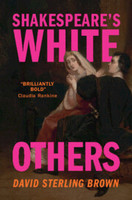
Examining the racially white 'others' whom Shakespeare creates in characters like Richard III, Hamlet and Tamora - figures who are never quite 'white enough' - this bold and compelling work emphasises how such classification perpetuates anti-Blackness and re-affirms white supremacy. David Sterling Brown offers nothing less here than a wholesale deconstruction of whiteness in Shakespeare's plays, arguing that the 'white other' was a racialized category already in formation during the Elizabethan era - and also one to which Shakespeare was himself a crucial contributor. In exploring Shakespeare's determinative role and strategic investment in identity politics (while drawing powerfully on his own life experiences, including adolescence), the author argues that even as Shakespearean theatrical texts functioned as engines of white identity formation, they expose the illusion of white racial solidarity. This essential contribution to Shakespeare studies, critical whiteness studies and critical race studies is an authoritative, urgent dismantling of dramatized racial profiling.
This is a reproduction of a book published before 1923. This book may have occasional imperfections such as missing or blurred pages, poor pictures, errant marks, etc. that were either part of the...
Shakespeare's last plays, the tragicomic Romances, are notoriously strange plays, riddled with fabulous events and incredible coincidences, magic and dream. These features have sometimes been...
This work has been selected by scholars as being culturally important, and is part of the knowledge base of civilization as we know it. This work was reproduced from the original artifact, and...
This is a reproduction of a book published before 1923. This book may have occasional imperfections such as missing or blurred pages, poor pictures, errant marks, etc. that were either part of the...
Sidney Homan defines a pivotal line as "a moment in the script that serves as a pathway into the larger play ... a magnet to which the rest of the play, scenes before and after, adheres." He offers...