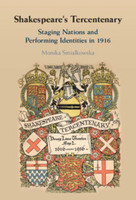
The worldwide commemorations of the three-hundredth anniversary of Shakespeare's death were held amid the global upheaval of the First World War. As empires battled for world domination and nations sought self-determination, diverse communities vied to claim Shakespeare as their own, to underpin their sense of collective identity and cohesion. Unearthing previously unknown Tercentenary events in Europe, the British Empire, and the USA, Monika Smialkowska demonstrates that the 1916 Shakespeare commemorators did not speak with one unified voice. Tributes by marginalised social, ethnic, and racial groups often challenged the homogenising narratives of the official celebrations. Rather than the traditionally patriotic Bard, used to support totalising versions of national or imperial identity, this study reveals Shakespeare as a site of debate and contestation, in which diverse voices - local and global, nationalist and universalist, militant and pacifist - combined and clashed in a fascinating, open-ended dialogue.
This catalog of the 1916 Shakespeare Tercentenary Exhibition in Philadelphia offers a fascinating glimpse into the history of Shakespearean scholarship and performance in America. It includes...
""The Tercentenary Of William Shakespeare: A Eulogium"" is a book written by James Samuel Stone in 1916 to commemorate the 300th anniversary of the death of William Shakespeare. The book is a tribute...
This book is a long poem celebrating the life and work of William Shakespeare on the occasion of the 300th anniversary of his birth. The author weaves together biographical details with poetic...
This work has been selected by scholars as being culturally important, and is part of the knowledge base of civilization as we know it.This work is in the "public domain in the United States of...
This work has been selected by scholars as being culturally important, and is part of the knowledge base of civilization as we know it. This work was reproduced from the original artifact, and...