
Trending Bestseller

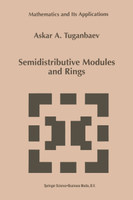
Semidistributive Modules and Rings

No reviews yet Write a Review
Paperback / softback
15 October 2012
RRP: $93.49
$91.62
Ships in 3-5 business days
Hurry up! Current stock:
A module M is called distributive if the lattice Lat(M) of all its submodules is distributive, i.e., Fn(G + H) = FnG + FnH for all submodules F,G, and H of the module M. A module M is called uniserial if all its submodules are comparable with respect to inclusion, i.e., the lattice Lat(M) is a chain. Any direct sum of distributive (resp. uniserial) modules is called a semidistributive (resp. serial) module. The class of distributive (resp. semidistributive) modules properly cont.ains the class ofall uniserial (resp. serial) modules. In particular, all simple (resp. semisimple) modules are distributive (resp. semidistributive). All strongly regular rings (for example, all factor rings of direct products of division rings and all commutative regular rings) are distributive; all valuation rings in division rings and all commutative Dedekind rings (e.g., rings of integral algebraic numbers or commutative principal ideal rings) are distributive. A module is called a Bezout module or a locally cyclic module ifevery finitely generated submodule is cyclic. If all maximal right ideals of a ring A are ideals (e.g., if A is commutative), then all Bezout A-modules are distributive.

You Can Find This Book In

    Book Details
    ISBN-13
    9789401061360
    Author
    Askar Tuganbaev
    Publisher
    Springer Nature B.V.
    Published
    15 October 2012
    Format
    Paperback / softback

    This product hasn't received any reviews yet. Be the first to review this product!

    RRP: $93.49
    $91.62
    Ships in 3-5 business days
    Hurry up! Current stock:

    Semidistributive Modules and Rings

    RRP: $93.49
    $91.62

    Description

    A module M is called distributive if the lattice Lat(M) of all its submodules is distributive, i.e., Fn(G + H) = FnG + FnH for all submodules F,G, and H of the module M. A module M is called uniserial if all its submodules are comparable with respect to inclusion, i.e., the lattice Lat(M) is a chain. Any direct sum of distributive (resp. uniserial) modules is called a semidistributive (resp. serial) module. The class of distributive (resp. semidistributive) modules properly cont.ains the class ofall uniserial (resp. serial) modules. In particular, all simple (resp. semisimple) modules are distributive (resp. semidistributive). All strongly regular rings (for example, all factor rings of direct products of division rings and all commutative regular rings) are distributive; all valuation rings in division rings and all commutative Dedekind rings (e.g., rings of integral algebraic numbers or commutative principal ideal rings) are distributive. A module is called a Bezout module or a locally cyclic module ifevery finitely generated submodule is cyclic. If all maximal right ideals of a ring A are ideals (e.g., if A is commutative), then all Bezout A-modules are distributive.

    You Can Find This Book In

      This Book Is Categorised As