A primary problem in the area of natural language processing has been that of semantic analysis. This book aims to look at the semantics of natural languages in context. It presents an approach to the computational processing of English text that combines current theories of knowledge representation and reasoning in Artificial Intelligence with the latest linguistic views of lexical semantics. This results in distinct advantages for relating the semantic analysis of a sentence to its context. A key feature is the clear separation of the lexical entries that represent the domain-specific linguistic information from the semantic interpreter that performs the analysis. The criteria for defining the lexical entries are firmly grounded in current linguistic theories, facilitating integration with existing parsers. This approach has been implemented and tested in Prolog on a domain for physics word problems and full details of the algorithms and code are presented. Semantic Processing for Finite Domains will appeal to postgraduates and researchers in computational linguistics, and to industrial groups specializing in natural language processing.
This book presents the creation of a bilingual thesaurus (Italian and English), and its conversion into an ontology system, oriented to the Cybersecurity field of knowledge term management and...
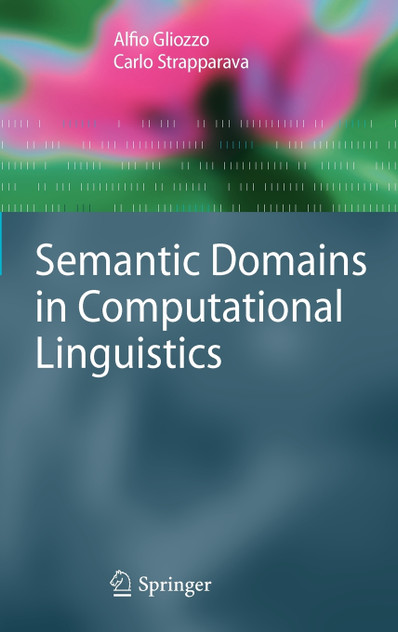
Semantic fields are lexically coherent - the words they contain co-occur in texts. In this book the authors introduce and define semantic domains, a computational model for lexical semantics inspired...
Research in semantics is conducted in a wide variety of disciplines, and the strength of this book is in bringing those areas together in one volume. Contributions come from an international group of...
This book discusses the semantic foundations of concurrent systems with nondeterministic and probabilistic behaviour. Particular attention is given to clarifying the relationship between testing and...
Research in robust open-domain text processing has seen considerable progress in the last couple of decades. It is probably fair to say that language technology tools have reached satisfactory...