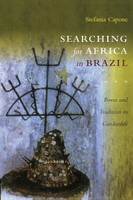
Searching for Africa in Brazil is a learned exploration of tradition and change in Afro-Brazilian religions. Focusing on the convergence of anthropologists' and religious leaders' exegeses, Stefania Capone argues that twentieth-century anthropological research contributed to the construction of an ideal Afro-Brazilian religious orthodoxy identified with the Nago (Yoruba) cult in the northeastern state of Bahia. In contrast to other researchers, Capone foregrounds the agency of Candomble leaders. She demonstrates that they successfully imposed their vision of Candomble on anthropologists, reshaping in their own interest narratives of Afro-Brazilian religious practice. The anthropological narratives were then taken as official accounts of religious orthodoxy by many practitioners of Afro-Brazilian religions in Brazil. Capone draws on ten years of ethnographic fieldwork in Salvador de Bahia and Rio de Janeiro as she demonstrates that there is no pure or orthodox Afro-Brazilian religion. To illuminate the continuum of Afro-Brazilian religious practice and the tensions between exegetic discourses and rituals, Capone focuses on the figure of Exu, the sacred African trickster who allows communication between gods and men. Following Exu and his avatars, she discloses the centrality of notions of prestige and power---mystical and religious---in Afro-Brazilian religions. To explain how religious identity is constantly negotiated among social actors, Capone emphasizes the agency of practitioners and their political agendas in the "return to roots," or re-Africanization, movement, an attempt to recover the original purity of a mythical and legitimizing Africa.
"The translation of this outstanding work into English is a real service to scholars. Searching for Africa in Brazil is a well researched and carefully argued examination of the ongoing disputations about the origins and transformations in Candomble. Stefania Capone is particularly insightful regarding the role that outsiders have played in shaping disputes about authenticity, sources, and their relation to African origins."---Anani Dzidzienyo, Co-Editor of Neither Enemies nor Friends: Latinos, Blacks, Afro-Latinos
"Searching for Africa in Brazil is a major piece of scholarship. Through careful historical research and vivid ethnographic detail, Stefania Capone demonstrates that conceptual pairs such as pure/impure, religious/magical, traditional/modernized, and communal/individualistic have long played a major role in highly self-conscious and overtly politicized representations of Afro-Brazilian religion. This is so both in regard to practitioners' discourses aimed at legitimizing their forms of practice at the expense of their rivals' and in regard to the changing views of anthropologists who sought a definitional monopoly over what could count as `African,' `traditional,' and so forth."---Stephan Palmie, Author of Wizards and Scientists: Explorations in Afro-Cuban Modernity and Tradition