


Trending Bestseller
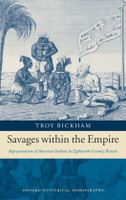
Savages within the Empire
Savages within the Empire explores how Britons perceived and represented American Indians during a time when the empire and its constituent peoples began to capture the nation's sustained attention for the first time. Troy Bickham considers an array of contexts,including newspapers, imperial policy, museum exhibits, the Enlightenment, missionary records, and the public outcry over the use of American Indians as allies during the American War of
Independence. He thus reveals the prevailing pragmatism with which Britons of all ranks approached the empire as well as its impact on British culture.
Hardback
07-December-2005
RRP:
$413.00
$309.00
Ships in 5–7 business days

Savages within the Empire
RRP:
$413.00
$309.00
Description
In 1720s London, a well-known band of young ruffians gave themselves crescent tattoos and adorned turbans in honour of their so-called 'mohamattan [Muslim]' Indian namesakes, the Mohawk. Few Britons noticed the gang's mistaken muddling of North American and Indian subcontinent geographies and cultures. Even fewer cared in an age in which 'Indian' was a catch-all term applied to theatre characters, philosophies, and objects whose only common characteristic often
was that they were not European. Yet just thirty years later, when the North American empire had entered centre stage, Londoners bought Iroquois tomahawks at auctions; provincial newspapers debated
Cherokee politics; women shopkeepers read aloud newspaper accounts of frontier battles as their husbands counted the takings; church congregations listened to the sermons of American Indian converts; families toured museum exhibits of American Indian artefacts; and Oxford dons wagered their bottles of port on the outcome of American wars. Focusing on the question, 'How did the British who remained in Britain perceive American Indians, and how did these perceptions reflect
and affect British culture?', Savages within the Empire explores both how Britons engaged with the peripheries of their Atlantic empire without leaving home, and, equally important, how their forged
understanding significantly affected the British and their rapidly expanding world. It draws from a wide range of evidence to consider an array of eighteenth-century contexts, including material culture, print culture, imperial government policy, the Church of England's missionary endeavours, the Scottish Enlightenment, and the public outcry over the use of American Indians as allies during the American War of Independence. By chronicling and exploring discussions and representations of
American Indians in these contexts, Troy Bickham reveals the proliferation of empire-related subjects in eighteenth-century British culture as well as the prevailing pragmatism with which Britons
approached them.
You May Like


Savage Empire
Lenardo, one of the most powerful Readers in the Aventine Empire, can read thoughts and sense details about objects and people miles away. His abilities are crucial, since the Empire is being...
$28.00


Captives of the Savage Empire
Torio, a renegade Reader, has broken his oath and taken his powers of telepathy to the Savage Lands. The Savage Adepts have driven back the walls of the Empire, using their mysterious gifts of...
$21.00

My Savage Empire
Let them hate me,as long as they fear me.I've ascended my throne.I wear my crown of thorns.Fancy that? I'm Queen of the August crime family.I'll rebuild my father's kingdom in blood and fire.With...
$39.00


Empire Within
This work seeks to illuminate the various ways in which the management of imperial or hegemonic spaces contribute to the emergence of more coercive apparatuses of state control.
$131.00