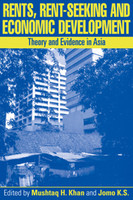
The concepts of rents and rent-seeking are central to any discussion of the processes of economic development. Yet conventional models of rent-seeking are unable to explain how it can drive decades of rapid growth in some countries, and at other times be associated with spectacular economic crises. This book argues that the rent-seeking framework has to be radically extended by incorporating insights developed by political scientists, institutional economists and political economists if it is to explain the anomalous role played by rent-seeking in Asian countries. It includes detailed analyses of Thailand, Malaysia, the Philippines, the Indian sub-continent, Indonesia and South Korea. This new critical and multidisciplinary approach has important policy implications for the debates over institutional reform in developing countries.
Rent seeking continues to be a topic of much discussion and debate within the political economy. This new study challenges previous assumptions and sets out a new analysis of the dynamics of rent and...
As the reader of this book probably already knows, I have devoted a great deal of time to the topic which is, rather unfortunately, named rent seeking. Rent seeking, the use of resources in actually...
Some time ago one of the editors (Gordon Tullock) stumbled on a paradox in the competition for rents. He asked a previous research assistant (William Hunter) to work out some examples and gave a ...
In China, rent seeking has been linked to the idea of the local developmental state in which rapid economic development is explained in terms of the promotion of village and township enterprises by...
It is now twenty years since the concept of rent-seeking was first devised by Gordon Tullock, though he was not responsible for coining the phrase itself. His initial insight has burgeoned over two...