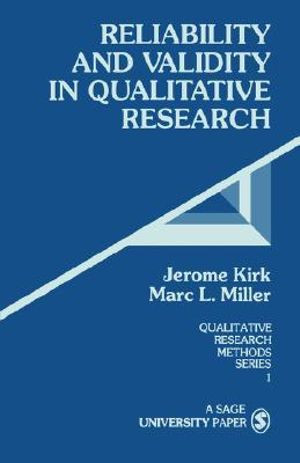
This guide explains how social scientists can evaluate the reliability and validity of empirical measurements, discussing the three basic types of validity: criterion related, content, and construct. In addition, the paper shows how reliability is assessed by the retest method, alternative-forms procedure, split-halves approach, and internal consistency method.
No other book reviews clinical neuropsychological assessment from an empirical psychometric perspective. In this completely revised and updated 2nd edition, the concepts and methods of psychometric...
Kirk and Miller define what is -- and what is not -- qualitative research. They suggest that the use of numbers in the process of recording and analyzing observations is less important than that the...
This guide for educators looks at major issues in language testing and provides knowledge, techniques, and strategies to design and implement assessments for use in classrooms that maximize fairness...
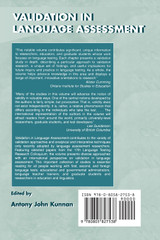
Validation in Language Assessment contributes to the variety of validation approaches and analytical and interpretive techniques only recently adopted by language assessment researchers. Featuring...
Improving the accuracy of a survey is the focus of Mark S. Litwinundefineds book, which shows how to assess and interpret the quality of survey data by thoroughly examining the survey instrument used...