Recent Progress in the Study of Variation, Heredity, and Evolution
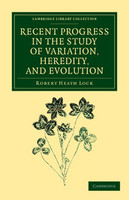
In the nineteenth century and beyond, scientists at Cambridge produced some of the most significant developments in the study of biological variation and inheritance. The work of William Bateson (several of whose books are also reissued in this series) was especially important in this regard. This book, first published in 1906 by the botanist Robert Heath Lock (1879-1915), lucidly traces these and other milestones in modern biological understanding. A readable account is given of the evolution of the discipline since the publication of Darwin's On the Origins of Species in 1859, taking in the biometrical contributions of Francis Galton and the research into mutation conducted by Hugo de Vries. The pioneering experiments of Gregor Mendel, and the more recent rediscovery of his laws of inheritance, are clearly contextualised so that non-specialist readers can appreciate the scientific progress that had been made in the half-century prior to the book's first publication.
This book explores the emerging concept of cultural DNA, considering its application across different fields and examining commonalities in approach. It approaches the subject from four different...
Explore the complex mechanisms of genetic inheritance and variation with this groundbreaking work of scientific inquiry. Heredity and Variation offers a comprehensive guide to the science of genetics...
This work has been selected by scholars as being culturally important, and is part of the knowledge base of civilization as we know it. This work was reproduced from the original artifact, and...
This work has been selected by scholars as being culturally important, and is part of the knowledge base of civilization as we know it.This work is in the "public domain in the United States of...