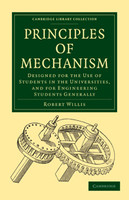
Robert Willis (1800-1875) was a scientist, inventor and architectural historian of international repute. As Jacksonian Professor of Natural and Experimental Philosophy at Cambridge, he demonstrated specially made mechanical devices to huge audiences. First published in 1841, Principles of Mechanism provided the theory behind the demonstrations. He defined mechanism as the means by which any relations of motion could be realised. The book was extremely influential, with all books in English, French, and German on the subject for the next generation adopting Willis' classification and nomenclature. He worked closely with William Whewell, whose Mechanics of Engineering was published in the same year. These two books established the science of mechanism, and provided study materials for the rapidly growing engineering profession. The work became a standard textbook for engineering and mathematics students, with a second edition issued in 1870.
This classic treatise on the principles of mechanics is still widely used as a textbook in universities and technical schools. With clear explanations, diagrams, and practical examples, Emerson lays...
""Principles of Mechanics: And Their Application to Prime Movers, Naval Architecture, Iron Bridges, Water Supply, Etc."" is a comprehensive book written by William J. Millar in 1874. The book covers...
This work has been selected by scholars as being culturally important, and is part of the knowledge base of civilization as we know it. This work was reproduced from the original artifact, and...
The standard work in the fundamental principles of quantum mechanics, indispensable both to the advanced student and to the mature research worker, who will always find it a fresh source of knowledge...