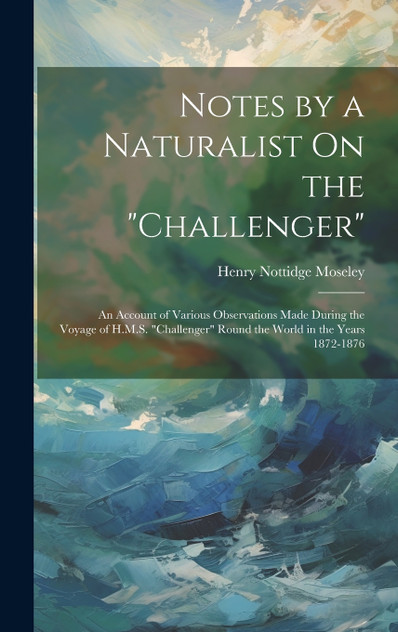
The Challenger Expedition of 1872-6 was conceived to examine the deep sea floor worldwide and disprove the theory of a 'dead zone' in the oceans below a certain depth. Using a modified Royal Navy ship, the expedition sailed nearly 70,000 nautical miles across the globe, collecting oceanographic data and marine specimens, and laying the foundations for the science of oceanography by later publishing fifty volumes of reports. The naturalist Henry Moseley (1844-91) recounts the voyage in this 1879 work, covering visits to many remote islands and the taking of samples at hundreds of locations. The voyage's achievements included the collection of over 4,000 new marine species and the discovery of the world's deepest ocean trench (Challenger Deep). Moseley's observations on native peoples also proved important as traditional cultures were changing rapidly at the time. Illustrated with numerous woodcuts, this narrative illuminates an adventure of great scientific significance.
Henry Nottidge Moseley shares his observations on the natural world during the infamous voyage of the HMS Challenger in the late 19th century. This fascinating memoir offers insights into the ocean...
This work has been selected by scholars as being culturally important, and is part of the knowledge base of civilization as we know it.This work is in the "public domain in the United States of...
W.J. Broderip shares his musings as a naturalist in this charming and informative book. Featuring the author's observations of various flora and fauna, this collection of essays is a must-read for...
This work has been selected by scholars as being culturally important, and is part of the knowledge base of civilization as we know it.This work is in the "public domain in the United States of...
This work has been selected by scholars as being culturally important, and is part of the knowledge base of civilization as we know it. This work was reproduced from the original artifact, and...