Narrative of Four Journeys into the Country of the Hottentots, and Caffraria
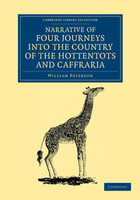
Later known as an administrator in Australia and founder of one of Tasmania's earliest settlements, William Paterson (1755-1810) was an army officer, naturalist and friend of Joseph Banks. Keenly interested in botany from childhood, in 1777 he was dispatched to Cape Colony on an expedition to collect plant specimens, many of which remain in the Natural History Museum. His accounts, published in 1789, are the observations and impressions of one of the first Europeans to venture into the south-east of modern-day South Africa. On his return to England he brought with him the skin and skeleton of a giraffe, which remained on show in the British Museum until the early twentieth century. He writes clearly and engagingly of the people, flora and fauna, assuring the reader that the work is 'a series of facts, noted down upon the spot, without any after additions'.
This work has been selected by scholars as being culturally important, and is part of the knowledge base of civilization as we know it. This work was reproduced from the original artifact, and...
This work has been selected by scholars as being culturally important, and is part of the knowledge base of civilization as we know it.This work is in the "public domain in the United States of...
The 18th century was a wealth of knowledge, exploration and rapidly growing technology and expanding record-keeping made possible by advances in the printing press. In its...
This work has been selected by scholars as being culturally important, and is part of the knowledge base of civilization as we know it.This work is in the "public domain in the United States of...
Follow the fascinating journey of Thomas Legh as he travels through Egypt and beyond the cataracts. This narrative provides a firsthand account of the people, landscapes, and cultures encountered...