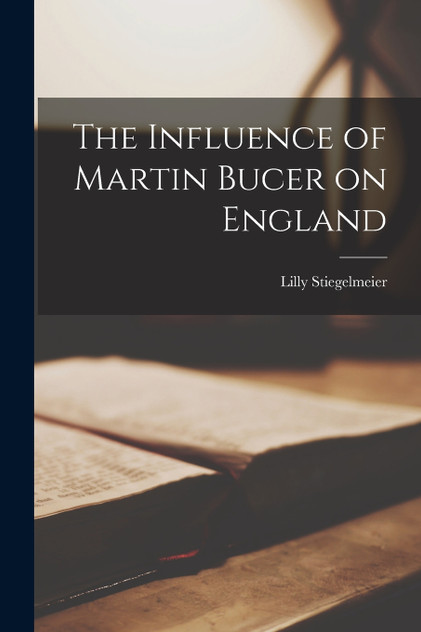
Martin Bucer (1491-1551) was one of the most important sixteenth-century Reformers, who became leader of the Reformed Churches in Switzerland and South Germany after the death of Zwingli. An international team of specialists on Bucer (several of them involved in the new critical edition of his works) highlight his contribution in thought and practice to building the community of the Church - in Strasbourg, but also elsewhere in Europe, and in England, where he spent the last years of his life in Cambridge. The issues raised emphasise Bucer's distinctiveness, as a Reformer of the Church and its ordered life, as well as raising matters of contemporary significance, such as Church-state relations, Protestant-Catholic unity, and tensions between a church of true believers and a 'people's' church.
This work has been selected by scholars as being culturally important, and is part of the knowledge base of civilization as we know it.This work is in the "public domain in the United States of...
This work has been selected by scholars as being culturally important and is part of the knowledge base of civilization as we know it.This work is in the public domain in the United States of...
Studienarbeit aus dem Jahr 2006 im Fachbereich Theologie - Historische Theologie, Kirchengeschichte, Note: 2,0, Universität Hamburg, Veranstaltung: Hauptseminar: "Abendmahl im Konflikt: Die...
Presents in the English language, and in convenient-size soft cover volumes, a selection of the most indispensable Christian treatises written before the end of the sixteenth century. These books...