Trending Bestseller

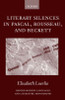
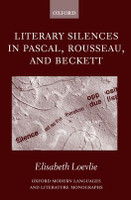
Literary Silences in Pascal, Rousseau, and Beckett

No reviews yet Write a Review
To explore literary silence is to explore the relationships between literary texts and the silence of the ineffable. Philosophical and critical accounts tend to operate with a dualistic understanding of silence as the negative other of text. This study, however, seeks to place silence within the literary text. Central to this theoretical endeavour are thinkers like Blanchot, Derrida, Gadamer and Vattimo, and the result is a fundamental challenge to our ideas of silence and text. The study continues to draw on the ideas of Kierkegaard and Bataille to develop an effective methodology for reading such literary silences.
Hardback
01-January-2004
RRP: $377.00
$316.00
Ships in 3-5 business days
Hurry up! Current stock:
To explore literary silence is to explore the relationships between literary texts and the silence of the ineffable. It is to enquire what dynamics texts develop as they strive to 'say the unsayable', and it is to think literature as a silence that speaks itself. This study describes these literary and silent dynamics through readings of Pascal's Pensées, Rousseau's Rêveries, and Beckett's trilogy Molloy, Malone meurt, and L'Innommable. It contributes to our understanding of three major writers and challenges our idea of what silence is. The subject of silence and of the ineffable has a long philosophical and critical tradition. A careful study of this tradition reveals the dominance of a limiting dualistic understanding of silence and its relationship to noise or language: silence becomes the negative other, the beyond, about which there remains nothing to say. The study of literary silence seeks rather to trace a language that becomes its own silence. It compromises the attempt to think a silence that moves within and through texts, that is inherent to the literary expression. Central to this theoretical endeavour are thinkers like Derrida, Deleuze, Gadamer, and Vattimo (among several others).The theoretical understanding of silence permits an effective methodology for reading literary silence. Notions of repetition, the aporia and the implosion, which are developed in reference to Kierkegaard and Bataille, describe textual strategies of literary silence and structure the readings. Finally, the reading of literary silence has its point of reference in writers like Mallarmé, Blanchot, and Beckett. It is their texts that have taught us to become topological readers, to move in and out of texts' movements; they have shown us how the literary expression is irreducible to linear, meaning oriented language. As readers of such texts we have been prepared to read the dynamics of the unsayable, and finally to start discerning the silences of the literary.

This product hasn't received any reviews yet. Be the first to review this product!

RRP: $377.00
$316.00
Ships in 3-5 business days
Hurry up! Current stock:

Literary Silences in Pascal, Rousseau, and Beckett

RRP: $377.00
$316.00

Description

To explore literary silence is to explore the relationships between literary texts and the silence of the ineffable. It is to enquire what dynamics texts develop as they strive to 'say the unsayable', and it is to think literature as a silence that speaks itself. This study describes these literary and silent dynamics through readings of Pascal's Pensées, Rousseau's Rêveries, and Beckett's trilogy Molloy, Malone meurt, and L'Innommable. It contributes to our understanding of three major writers and challenges our idea of what silence is. The subject of silence and of the ineffable has a long philosophical and critical tradition. A careful study of this tradition reveals the dominance of a limiting dualistic understanding of silence and its relationship to noise or language: silence becomes the negative other, the beyond, about which there remains nothing to say. The study of literary silence seeks rather to trace a language that becomes its own silence. It compromises the attempt to think a silence that moves within and through texts, that is inherent to the literary expression. Central to this theoretical endeavour are thinkers like Derrida, Deleuze, Gadamer, and Vattimo (among several others).The theoretical understanding of silence permits an effective methodology for reading literary silence. Notions of repetition, the aporia and the implosion, which are developed in reference to Kierkegaard and Bataille, describe textual strategies of literary silence and structure the readings. Finally, the reading of literary silence has its point of reference in writers like Mallarmé, Blanchot, and Beckett. It is their texts that have taught us to become topological readers, to move in and out of texts' movements; they have shown us how the literary expression is irreducible to linear, meaning oriented language. As readers of such texts we have been prepared to read the dynamics of the unsayable, and finally to start discerning the silences of the literary.
Customers Also Viewed