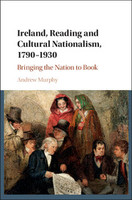
Ireland, Reading and Cultural Nationalism, 1790-1930
The emergence of an Irish 'common reader' in the nineteenth century had significant implications for the evolution of Irish cultural nationalism. The rise of literacy rates prompted a cultural crisis, with nationalists fearing that the beneficiaries of mass education were being drawn to populist publications emanating from London which were having the effect of eroding Irish identity and corrupting Irish morals. This fear prompted an intensification of cultural nationalist activity at the turn of the century. Andrew Murphy's study, which includes a chapter on W. B. Yeats and the Irish reader, moves freely between historical and literary analysis, and demonstrates how a developing sense of cultural crisis served as an engine for the Irish literary revival. Examining responses to Irish reading habits advanced by a wide range of cultural commentators, Murphy provides a nuanced discussion of theories of nationalism and examines attempts finally to control reading habits through the introduction of censorship.
This work has been selected by scholars as being culturally important, and is part of the knowledge base of civilization as we know it. This work was reproduced from the original artifact, and...
This volume focuses on how travel writing contributed to cultural and intellectual exchange in and between the Dutch- and German-speaking regions from the 1790s to the twentieth-century interwar...