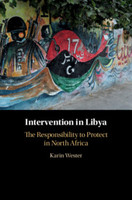
The 2011 crisis in Libya represents the first case in which the international community invoked 'the Responsibility to Protect' principle, adopted in 2005 by UN member states, to justify coercive measures including sanctions and the use of military force. In this study, Karin Wester meticulously reconstructs and analyzes the evolution of the Libyan crisis, the international community's response, and the manner in which the 'Responsibility to Protect' was applied. Drawing on a wide variety of primary sources including in-depth interviews with politicians and diplomats, this comprehensive account of the 2011 intervention in Libya redresses popular narratives asserting that the intervention was driven primarily by western (neo-colonial) interests or by a desire for regime change. Instead, Wester reveals how the 'Responsibility to Protect' principle was realized to a considerable extent, but also how it provided a highly fragile basis for military enforcement action. Incorporating perspectives from international law, political science and history, this is a compelling and thought-provoking examination of the real-world application of a principle that is deeply rooted in history but presents daunting challenges in implementation.
This book argues that the Responsibility to Protect (R2P) the Libyan people played an important role in the U.S.'s decision to act, both in terms of how the language of deliberation was framed and...
This book explores the contradictions in Britain's humanitarian and military intervention in Libya and Syria, beginning with the Arab spring in 2010. The book assesses the contradictions between the...
This book brings together internationally renowned academics from Europe and North America offering a uniquely comprehensive and timely analysis of the intervention in Libya in 2011. The military...