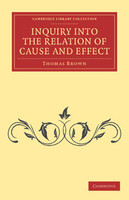
Scottish philosopher Thomas Brown (1778-1820) held the chair of moral philosophy at the University of Edinburgh. He was distinguished for his work in the philosophy of mind and causation, and was a founder member of the Edinburgh Review. At the beginning of the nineteenth century, controversy arose over John Leslie being appointed to the chair of mathematics at the university. City ministers opposed him because he defended Hume's view of causation, which was seen as being incompatible with the existence of God. In 1805 Brown wrote a pamphlet, Observations on the Nature and Tendency of the Doctrine of Mr. Hume Concerning the Relation of Cause and Effect, which among other things aimed to show that Hume's theory was compatible with belief in God. This book, first published in 1818, is the third edition of that original pamphlet, which grew to become a thorough examination of the philosophy of causation.
This work has been selected by scholars as being culturally important, and is part of the knowledge base of civilization as we know it.This work is in the "public domain in the United States of...
This groundbreaking study investigates the relationship between high wages and productivity, making the case that paying laborers more can have a positive impact on the overall economy. Jacob...
This is a reproduction of a book published before 1923. This book may have occasional imperfections such as missing or blurred pages, poor pictures, errant marks,...
In this classic work, Henry George presents his theory that poverty is caused not by overpopulation or moral failings, but rather by the unequal distribution of wealth and land. He argues for a...