Trending Bestseller

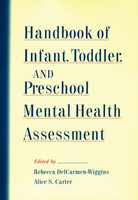
Handbook of Infant, Toddler, and Preschool Mental Health Assessment

No reviews yet Write a Review
Infant and toddler mental health is a growing area of interest for psychiatrists, child psychologists, pediatricians, and educators. Expanding research in this area highlights the need for early identification and assessment of mental health problems and risk factors in infants and toddlers. In addition, public policy and recent legislation have offered new opportunities to provide services to infants and toddlers who are at risk or are already exhibiting delays or deviance in social and emotional functioning. This handbook is the first of its kind to bring together the several new diagnostic and assessment approaches for working with infant and toddler mental health.
Hardback
01-June-2004
RRP: $247.00
$137.00
Ships in 5–7 business days
Hurry up! Current stock:
The Handbook of Infant, Toddler, and Preschool Mental Health Assessment brings together, for the first time, leading clinical researchers to provide empirically based recommendations for assessment of social-emotional and behavior problems and disorders in the earliest years. Each author presents state-of-the-art information on scientifically valid, developmentally based clinical assessments and makes recommendations based on the integration of developmental theory, empirical findings, and clinical experience. Though the field of mental health assessment in infants and young children lags behind work with older children and adults, recent scientific advances, including new measures and diagnostic approaches, have led to dramatic growth in the field. The editors of this exciting new work have assembled an extraordinary collection of chapters that thoroughly discuss the conceptualizations of dysfunction in infants and young children, current and new diagnostic criteria, and such specific disorders as sensory modulation dysfunction, sleep disorders, eating and feeding disorders, autistic spectrum disorders, anxiety disorders, posttraumatic stress disorder, and ADHD. Chapters further highlight the importance of incorporating contextual factors such as parent-child relationship functioning and cultural background into the assessment process to increase the validity of findings. Given the comprehensiveness of this groundbreaking volume in reviewing conceptual, methodological, and research advances on early identification, diagnosis, and clinical assessment of disorders in this young age group, it will be an ideal resource for teachers, researchers, and a wide variety clinicians including child psychologists, child psychiatrists, early intervention providers, early special educators, social workers, family physicians, and pediatricians.

This product hasn't received any reviews yet. Be the first to review this product!

RRP: $247.00
$137.00
Ships in 5–7 business days
Hurry up! Current stock:

Handbook of Infant, Toddler, and Preschool Mental Health Assessment

RRP: $247.00
$137.00

Description

The Handbook of Infant, Toddler, and Preschool Mental Health Assessment brings together, for the first time, leading clinical researchers to provide empirically based recommendations for assessment of social-emotional and behavior problems and disorders in the earliest years. Each author presents state-of-the-art information on scientifically valid, developmentally based clinical assessments and makes recommendations based on the integration of developmental theory, empirical findings, and clinical experience. Though the field of mental health assessment in infants and young children lags behind work with older children and adults, recent scientific advances, including new measures and diagnostic approaches, have led to dramatic growth in the field. The editors of this exciting new work have assembled an extraordinary collection of chapters that thoroughly discuss the conceptualizations of dysfunction in infants and young children, current and new diagnostic criteria, and such specific disorders as sensory modulation dysfunction, sleep disorders, eating and feeding disorders, autistic spectrum disorders, anxiety disorders, posttraumatic stress disorder, and ADHD. Chapters further highlight the importance of incorporating contextual factors such as parent-child relationship functioning and cultural background into the assessment process to increase the validity of findings. Given the comprehensiveness of this groundbreaking volume in reviewing conceptual, methodological, and research advances on early identification, diagnosis, and clinical assessment of disorders in this young age group, it will be an ideal resource for teachers, researchers, and a wide variety clinicians including child psychologists, child psychiatrists, early intervention providers, early special educators, social workers, family physicians, and pediatricians.

Customers Also Viewed