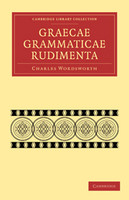

Charles Wordsworth's Graecae Grammaticae Rudimenta in Usum Scholarum was, for decades, the foundational Greek grammar in England. Wordsworth, a nephew of the poet, a master at Winchester College and later bishop of St Andrews, Dunkeld, and Dublane, used his expertise in teaching the classical languages to produce a clear, practical introduction to Greek, beginning with the alphabet and progressing through the declension of nouns and adjectives, the conjugations of verbs, and the fundamentals of syntax. In striving not to replace the standard Eton Grammar but rather to refine and revise it, Wordsworth succeeded in composing a book that one fellow master called 'most distinct, easy of conception for the boys, and lucidly arranged'. This ninth edition (1853) includes the author's full emendations to the text.
Examination Questions on the Graecae Grammaticae Rudimenta (1845) is a book written by Charles Engledow. This book is a collection of examination questions on the rudiments of Greek grammar, which...
Rudimenta Grammaticae Hebraeae: Secundum Praecepta A. Schultensii Clarissimi Viri Conscripta (1766) est liber a Davide Kocher editus, qui continet fundamenta grammaticae Hebraicae secundum praecepta...
Latinae Grammaticae Rudimenta is a book written by John William Donaldson and published in 1853. The book is aimed towards young beginners who are interested in learning Latin grammar. It is an...
Libellus ""Graecae Grammaticae: Institutio Prima"" est scriptus a Benjamin Hall Kennedy anno MDCCCXLVII. Hoc opus est institutio fundamentalis in grammaticam Graecam, quae est lingua antiqua...
Theophilus Golius's 'Grammatica Graeca' is an influential work in the field of ancient Greek linguistics. It provides a thorough overview of Greek grammar and syntax, and includes a detailed...