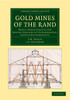
The mining engineer and petrologist Frederick Henry Hatch (1864-1932) left the Geological Survey of Great Britain in 1892, relocating to South Africa. He worked for De Beers and with John Hays Hammond for Cecil Rhodes, finding important new gold fields in Matabeleland and Mashonaland. Control of the gold mines was a significant factor in the tension between Dutch and English settlers that would result in the Second Boer War in 1899. Prior to this, Rhodes and Hammond were behind the abortive Jameson Raid, but Hatch had returned to England briefly and was not implicated. This 1895 work, written with South African mining engineer J. A. Chalmers, reveals the extent of gold reserves in the Transvaal, and the engineering skills needed to exploit them. It deals with geological, economic and legal aspects of the mining industry, remaining of interest to historians of South Africa and the British Empire.
This work has been selected by scholars as being culturally important, and is part of the knowledge base of civilization as we know it.This work is in the "public domain in the United States of...
Godly thriving leaders are precious and valuable, but developing those leaders is not easy. Many leaders feel stuck, tired and frustrated in their growth and calling. This can change. In Mining for...
Holly Frank is in trouble. The deadly kind.She and her sister must evade the authorities and the criminals who want them dead. Including Elijah North. The man who took her heart in Paris, her body in...
Scripture's truths are like nuggets of gold in a reserve. To be its best, gold must be mined, refined, and designed as bullion, coins, jewelry, and the like. To get the best from the truthsof...
This is a reproduction of a book published before 1923. This book may have occasional imperfections such as missing or blurred pages, poor pictures, errant marks, etc. that were either part of the...