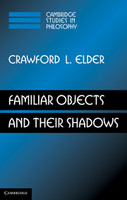

Most contemporary metaphysicians are sceptical about the reality of familiar objects such as dogs and trees, people and desks, cells and stars. They prefer an ontology of the spatially tiny or temporally tiny. Tiny microparticles 'dog-wise arranged' explain the appearance, they say, that there are dogs; microparticles obeying microphysics collectively cause anything that a baseball appears to cause; temporal stages collectively sustain the illusion of enduring objects that persist across changes. Crawford L. Elder argues that all such attempts to 'explain away' familiar objects project downwards, onto the tiny entities, structures and features of familiar objects themselves. He contends that sceptical metaphysicians are thus employing shadows of familiar objects, while denying that the entities which cast those shadows really exist. He argues that the shadows are indeed really there, because their sources - familiar objects - are mind-independently real.
This work has been selected by scholars as being culturally important and is part of the knowledge base of civilization as we know it.This work is in the public domain in the United States of...
Hear, a wonder (and a thinking) from an eternal questing set in time; here, a look at Parsafal as the hinge of this tale of nonviolent love. Listen with your heart unimpeded by any thirsts for...
This work has been selected by scholars as being culturally important, and is part of the knowledge base of civilization as we know it. This work was reproduced from the original artifact, and...