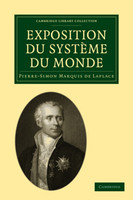
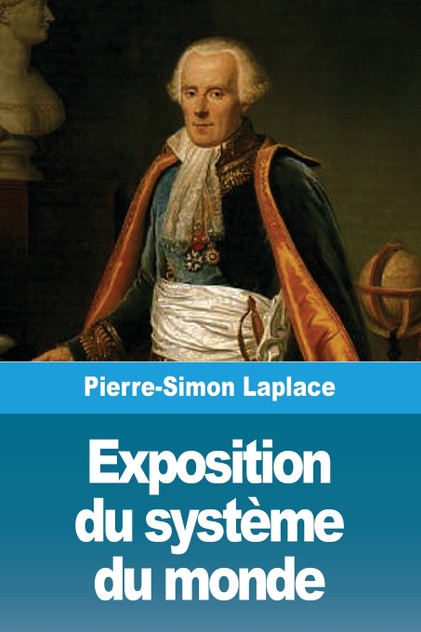
The work of the Marquis de Laplace (1749-1827) was enormously influential on the development of mathematical physics, astronomy and statistics. His Exposition du système du monde (first published in 1796) is often regarded as the most important book on mechanics after Newton's Principia Mathematica, and the elegance and clarity of its style won Laplace a seat in the Académie Française. The book, which was translated into English in 1809, was intended to 'offer a complete solution of the great mechanical problem presented by the solar system'. It was in this work that Laplace offered his nebular hypothesis, which proposed that the solar system originated from the contraction and cooling of a cloud of incandescent gas. The book, here in its second edition of 1799, is an introduction to Laplace's multi-volume masterpiece, the Traité de Mécanique Céleste, of which Mary Somerville's English version is also reissued in this series.
Après ses travaux sur la mécanique céleste, Laplace se propose d'écrire un ouvrage qui aurait dû offrir une solution complète au grand problème de la mécanique représenté par le système solaire et...
This is a reproduction of a book published before 1923. This book may have occasional imperfections such as missing or blurred pages, poor pictures,...
This is a reproduction of a book published before 1923. This book may have occasional imperfections such as missing or blurred pages, poor pictures, errant marks, etc. that were either part of the...