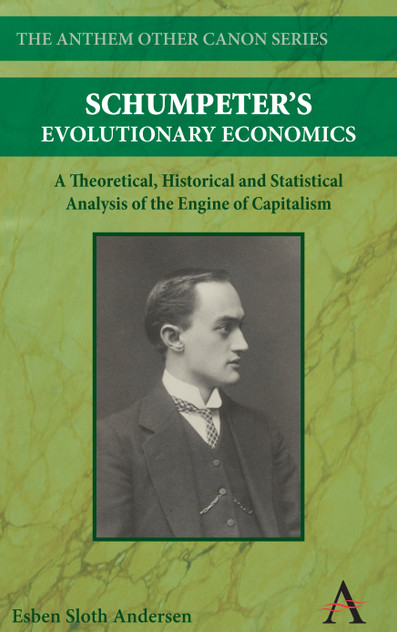
This volume contains eleven papers - some theoretical, others empirical - given at the 1986 founding meeting of the International Joseph A. Schumpeter Society in Augsburg. By raising questions and offering additional statistical evidence, they further stimulate interest and discussion about the kinds of intuitive ideas that Schumpeter introduced in his seminal period before World War I. Whatever may be the academic mainline trend in economics, two policy-oriented 'disequilibrium' schools have flourished and still thrive: one stresses the need for social redistribution as a counterweight to a negative propensity to unemployment; the other emphasizes the explicit roles of the dynamic entrepreneur, innovation and stressful competition in stimulating economic growth. And while it is possible that the heyday of the demand-side 'age of Keynes' is passing, it also may be true that the time of the supply-side 'age of Schumpeter' is now emerging.
Economics is traditionally taken to be the social science concerned with the production, consumption, exchange, and distribution of wealth and commodities. Economists carefully track the comings and...
Joseph Schumpeter's views on innovation, entrepreneurship and creative destruction are widely cited in many fields of the social sciences, and are influential in policy and decision making, yet they...
The purpose of this book is to provide a guided tour through the theoretical foundations of spatial locations of firms and industries in an evolutionary economic framework. It addresses the issues of...