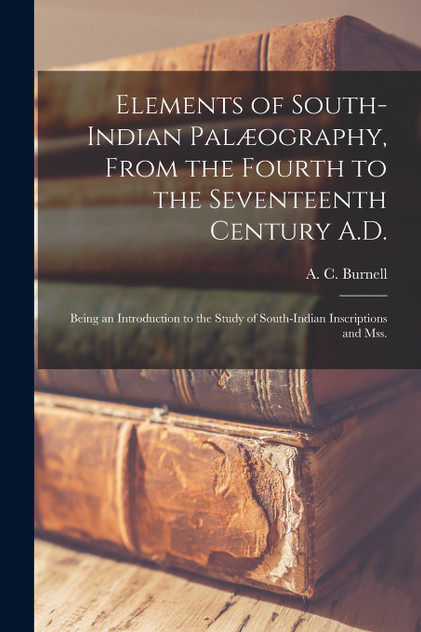

Elements of South-Indian Palaeography, from the Fourth to the Seventeenth Century, AD
Published in 1874, this groundbreaking monograph on the palaeography of southern India gained great scholarly acclaim. Arthur Coke Burnell (1840-82) served in the Indian Civil Service and as a judge, also building up a large collection of original or copied Sanskrit manuscripts. Originally intended as an introduction to his vast and pioneering Classified Index to the Sanskrit Manuscripts in the Palace at Tanjore (1880), this work won Burnell an honorary doctorate at the University of Strasbourg. Replete with documentary evidence, it contains copies and explanations of numerous texts, the decipherment of which threw new light upon an obscure chapter in the history of writing, offering new theories for dating the introduction of writing into India and the origin of southern Indian alphabets and numerals. Although Burnell's work has since been built on and sometimes superseded, this is still a much-cited resource in South Asian palaeography and epigraphy.
This work has been selected by scholars as being culturally important, and is part of the knowledge base of civilization as we know it.This work is in the "public domain in the United States of...
This work has been selected by scholars as being culturally important and is part of the knowledge base of civilization as we know it.This work is in the public domain in the United States of...
Sufism is often regarded as standing mystically aloof from its wider cultural settings. By turning this perspective on its head, Indian Sufism since the Seventeenth Century reveals the politics and...
This work has been selected by scholars as being culturally important, and is part of the knowledge base of civilization as we know it.This work is in the "public domain in the United States of...