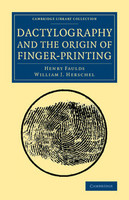
The Scottish doctor Henry Faulds (1843-1930) and the English judge Sir William James Herschel (1833-1917) both recognised the potential of fingerprints as a means of identification. While working in Japan, Faulds had developed his methods after noticing impressions on ancient pottery. Herschel, during his service as a magistrate in India, had introduced a system of using fingerprints as a way of preventing fraud. In the course of a lengthy controversy, Faulds sought to be acknowledged for the significance of his discoveries. Although there is no doubt that Faulds was first to publish on the subject, it was Herschel's work, begun in the 1850s, which was later developed by Galton and Henry as the tool of forensic science we know today. Reissued here together, these two works, first published in 1912 and 1916 respectively, are Faulds' overview of the subject and Herschel's account of his work in India.
"Dactylography or the Study of Finger-Prints" is a seminal work authored by Henry Faulds, a Scottish physician, and missionary, within the past due nineteenth century. Published in the medical...
This work has been selected by scholars as being culturally important, and is part of the knowledge base of civilization as we know it.This work is in the "public domain in the United States of...
The Making of the Modern Law: Legal Treatises, 1800-1926 includes over 20,000 analytical, theoretical and practical works on American and British Law. It includes the writings of...
The Making of the Modern Law: Legal Treatises, 1800-1926 includes over 20,000 analytical, theoretical and practical works on American and British Law. It includes the writings of major legal...
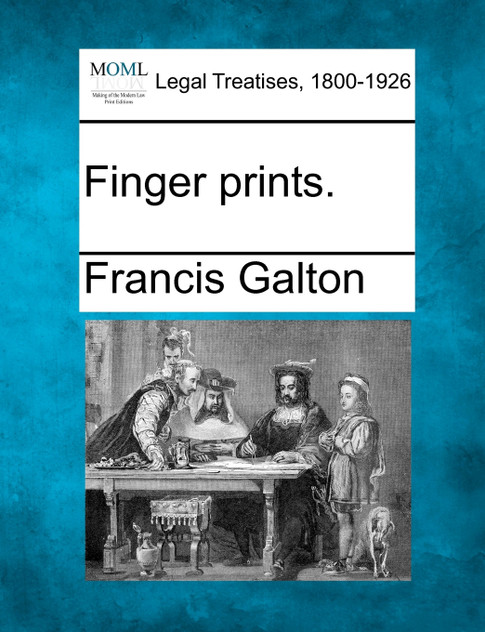
"I should say that one of the inducements to making these inquiries into personal identification has been to discover independent features suitable for hereditary investigation."-Sir Francis Galton,...