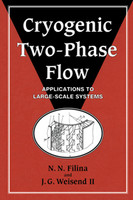
Cryogenic systems that involve two-phase (vapour-liquid) flows are widely used in industries such as aerospace, metallurgy, power engineering, and food production, as well as in high energy physics research. The purpose of this book is to describe characteristic features of cryogenic systems involving two-phase flow, create mathematical models of these systems, and then show how the models may be used to develop optimal designs for practical cryogenic systems. Since transient phenomena can produce severe and unexpected effects in cryogenic systems, the authors pay particular attention to this important topic. Examples in the book are drawn from cryogenic fluid transport, gasification, and the stabilisation of superconducting magnets. Much of this work is related to the development of large Russian systems in the areas of space technology, energy research, and particle physics.
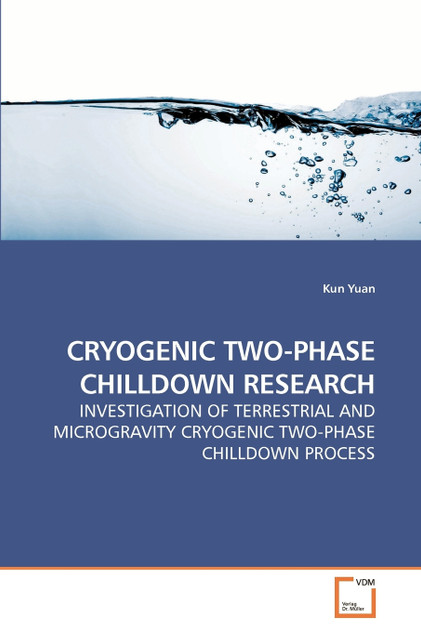
Chilldown process is a complicated process involves unsteady two-phase heat and mass transfer and initiates the cryogenic fluids transport. To advance the ...
This graduate text provides a unified treatment of the fundamental principles of two-phase flow and shows how to apply the principles to a variety of homogeneous mixture as well as separated...
Matter may be divided into four phases or states: solid, liquid, gas and plasma (ionized gas). The termfluid has been used as a general name for the last three states: liquid, gas, and plasma because...
This IMA Volume in Mathematics and its Applications TWO PHASE FLOWS AND WAVES is based on the proceedings of a workshop which was an integral part of the 1988-89 IMA program on NONLINEAR WAVES. The...