Trending Bestseller

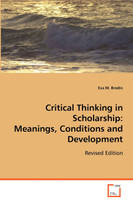
Critical Thinking in Scholarship

Meanings, Conditions and Development

Eva M. Brodin

No reviews yet Write a Review
Paperback / softback
27 August 2008
RRP: $126.87
$102.00
Ships in 5–7 business days
Hurry up! Current stock:
Critical thinking is a vital part of scholarship, yet the meaning of this notion and the conditions it presupposes are far from self-evident. In fact, critical thinking is understood in a number of ways, and depending on which meaning the notion of critical thinking is associated to, different conditions for its realization can be envisaged. Thus, in this book some of these meanings and conditions are explored, seeing the development of critical thinking both in relation to history and to contemporary lines of thought. It appears that critical thinking is a matter of dealing with abstract relationships, and that the scholarly critical thinker is directed towards mastering, understanding, or changing the world. Moreover, it emerges that critical thinking in scholarship is implicitly understood as a means for attaining normatively good ends. This is problematic, since critical thinking involves no assurance of ending in something good in itself. Therefore, it is argued that scholarly critical thinking receives its most critical feature when the intention, process and end constitute an interrelated constructive whole, which is permeated by the individual's sense of responsibility.

This product hasn't received any reviews yet. Be the first to review this product!

RRP: $126.87
$102.00
Ships in 5–7 business days
Hurry up! Current stock:

Critical Thinking in Scholarship

RRP: $126.87
$102.00

Description

Critical thinking is a vital part of scholarship, yet the meaning of this notion and the conditions it presupposes are far from self-evident. In fact, critical thinking is understood in a number of ways, and depending on which meaning the notion of critical thinking is associated to, different conditions for its realization can be envisaged. Thus, in this book some of these meanings and conditions are explored, seeing the development of critical thinking both in relation to history and to contemporary lines of thought. It appears that critical thinking is a matter of dealing with abstract relationships, and that the scholarly critical thinker is directed towards mastering, understanding, or changing the world. Moreover, it emerges that critical thinking in scholarship is implicitly understood as a means for attaining normatively good ends. This is problematic, since critical thinking involves no assurance of ending in something good in itself. Therefore, it is argued that scholarly critical thinking receives its most critical feature when the intention, process and end constitute an interrelated constructive whole, which is permeated by the individual's sense of responsibility.

Customers Also Viewed